Friday, December 4, 2009

Spitzer: The Non-Adulterous-Governor Edition

NASA's Spitzer Space Telescope (a.k.a. Hubble's jealous little brother) has been putting together a mosaic of the Milky Way Galaxy for the past year for exhibition at the Adler Planetarium in Chicago. The prototype image was released this week, and it allows us to view our galaxy in unprecedented ways:
As inhabitants of a flat galactic disk, Earth and its solar system have an edge-on view of their host galaxy, like looking at a glass dish from its edge. From our perspective, most of the galaxy is condensed into a blurry narrow band of light that stretches completely around the sky, also known as the galactic plane.
The image is composed of over 800,000 separate images, each of them hi-res, each likely showing more detail than your average desktop wallpaper. Aside from the mosaic at Adler, the images will also allow astronomers to do statistical searches, estimate populations of objects and evaluate the contexts of celestial objects.

The main event (click to embiggen, then click again via magnifying glass to double-embiggen):

Sunrise

So I decided to wake up early today.


Sunday, November 22, 2009

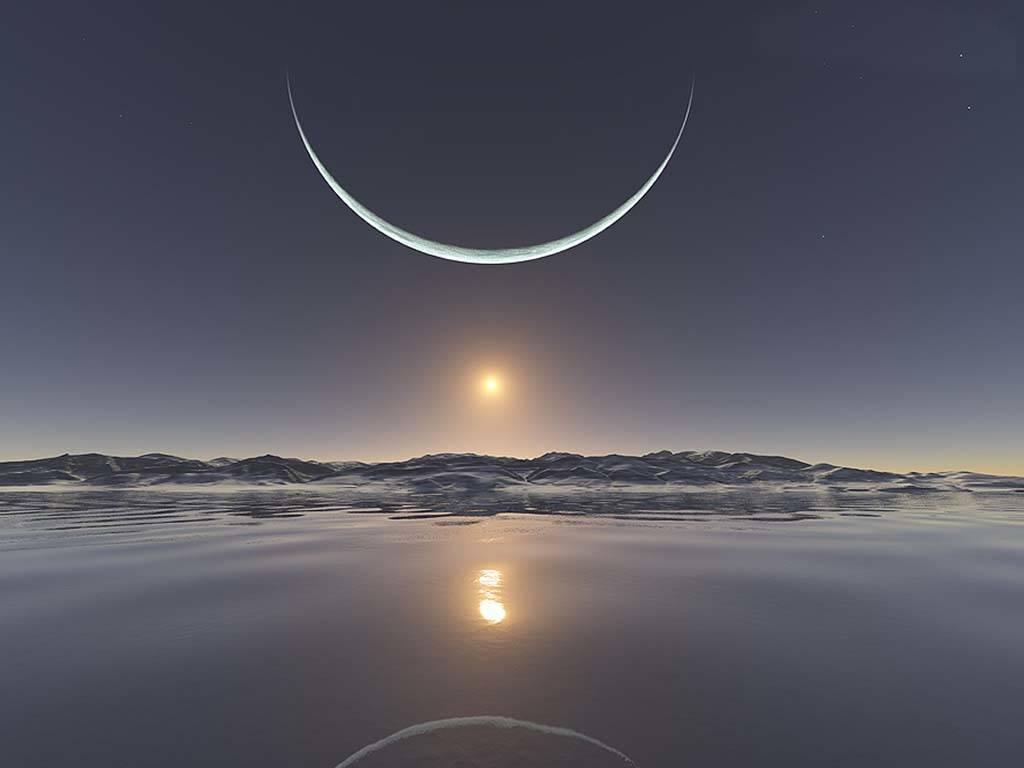
Sunset at the North Pole

(9:15:28 PM) kathryn: have you ever google image searched "north pole sunset"
(9:16:01 PM) ben: no
(9:16:09 PM) kathryn: well you should
(9:17:03 PM) ben: holy crap
(9:17:06 PM) ben: is that the moon?
(9:17:10 PM) kathryn: yeah
(9:17:22 PM) ben: hey
(9:17:26 PM) ben: kathryn. you. me.
(9:17:28 PM) ben: spring break.
(9:17:30 PM) ben: north pole.
(9:17:34 PM) kathryn: yeah, right
(9:17:36 PM) kathryn: nope.
(9:17:42 PM) kathryn: i want to go to the LOST island

If Only

The sky is as vast as it is diverse. When we gaze up into the night sky, we can see so many types of natural objects: stars, planets, meteors, comets, etc. But as diverse as they are, they have one thing in common--they're all round. From our perspective, aside from the Sun and moon, they're innocuous points of light.

It may seem obvious, but it's true. The closest non-round celestial "body" of course is Saturn's famous rings. It should be noted, though, that they are not actually solid rings but lots and lots of small particles of mostly ice and dust (which themselves are in fact round).

The main reason Earth doesn't have rings simply because it isn't big enough. Saturn, a gas giant, has relatively strong gravitational forces, which pulls the ring's particles in. (Fun fact: Jupiter also has rings--invisible rings!)

But what if Earth did have rings? What would it look like to us? Answer: Awesome.


Tuesday, November 17, 2009

"It was the kind of night a man could get some thinking done."

The above quote is actually the first sentence from a short story written by one of my fiction classmates. It also succinctly describes my endeavor last night, as I set out to catch me some meteors.

I went to sleep at 11 PM, woke up at 2 and met up with a friend at the apex of Chesterfield Rd. while donning a ravishing two-hoodie-camera-bulging-out-pocket-combo. Photographing a meteor is of course nearly impossible, and I brought the camera because I was about to traverse the exotic tundra of Northwest Oakland, U.S.A. in search of the best possible meteor viewing location, and such should be documented.

I would soon find that no such location existed. The clouds were like Swiss cheese--small holes here and there but very dense and hard to see through. Lights from streetlamps, hospitals and parking lots seemed to illuminate whichever pocket of the sky on which I currently focused my search. It was cold and windy, which made it hard for me to hold my camera steady and impossible to light a cigarette had my friend not been there to shield me.

At around 4 AM (when NASA says the shower should have peaked on the East Coast), we had yet to see any meteors. We alternately wandered around to find a better viewing spot and took sitting breaks wherever those spots were.

But wherever they were, no spot was "better" than the last. The city envelops the sky. It renders it partially inaccessible to city-dweller. There could have been a small cluster of meteors right in front of my eyes--UPMC Montefiore was just in the way.

So we just kind of sat a lot. The prolonged silences were mutually enjoyed. The sky, however inaccessible, is a nice backdrop for silence. It was the kind of night a man could get some thinking done.


This is where we finally settled, finally leaving at 4:14 EST.
Believe it or not, it was one of the more conducive lighting schemes.

Monday, November 16, 2009

The Pittsburgher's Guide to the 2009 Leonids Meteor Shower

Tonight through early tomorrow morning, the annual Leonids meteor shower will peak. This occurs as the Earth passes through a cloud of particles left over from deteriorated comets.

Obviously, for optimal viewing, you'll want to be in the darkest place possible. This may prove difficult for us city-dwellers, but NASA has a neat little widget on its website that lets you input your coordinates, conditions and viewing times, offering a rough estimate of the number of meteors you can expect to see. Below is the chart for greater Pittsburgh:


Note that the peak time for viewing will be at 2:28 local time, and we can expect to see around 2.5 meteors per hour then. Not spectacular by any stretch, but still more meteors than one can expect to see over the course of an entire year.

Sunday, November 15, 2009

Intro to the Drake Equation

Amid all of last week's Carl Sagan festivities, I came across this clip from the 1980 mini-series, "Cosmos," which Sagan helped write, produce, and starred in.

I first learned about the Drake equation in the very first class I ever attended at Pitt. It was called "Intelligent Life in the Universe," and the long-term goal of the class was to tangibly estimate the likelihood of human-like species existing elsewhere in the Universe. The equation (which was the culminating lesson of the course), was formulated by Dr. Frank Drake in 1960. Basically, what the formula does is take all of the variables involved in determining the existence of aliens (number of stars in the Universe, number of galaxies, evolutionary conditions, etc.) and enables a rough estimate for the number of intelligent civilizations in the Universe at a given time.

The clip below shows Sagan guiding the viewer through the equation. The kicker comes at the end, though--the difference between an incredibly populated Universe and a barren one hinges on civilizations' ability not to destroy themselves. In other words, if intelligent societies can avoid self-destruction, then the Universe is likely filled with worlds such as our own.


Yet another case for the disarmament of Iran.

Bombing the Moon: Update

You may remember that last month, NASA bombed the moon. The purpose was to see if water and ice would kick up amid all the debris, and the tests just came back:

It's official: the moon is pregnant. Just kidding--its water just broke. Via the NYT Science section:

“Indeed yes, we found water,” Anthony Colaprete, the principal investigator for NASA’s Lunar Crater Observation and Sensing Satellite, said in a news conference. “And we didn’t find just a little bit. We found a significant amount.”

The confirmation of scientists’ suspicions is welcome news to explorers who might set up home on the lunar surface and to scientists who hope that the water, in the form of ice accumulated over billions of years, holds a record of the solar system’s history.

So, why is this important? Well, in terms of the long term viability of our species, water might be the first natural resource to go. If humans have a future on Earth (or elsewhere), the difference between trace amounts of lunar water and large deposits (apparently among the LCROSS findings) is roughly equal to the difference between a species that fizzles in the next few millennia and one that lasts much, much longer.

Sunday, November 8, 2009

Astronomusic v. 3: Carl Sagan in Auto-Tune

Speaking of Carl Sagan, here's a tribute courtesy of John Boswell (through his project Symphony of Science, which was promoted on the science podcast The Skeptics' Guide to the Universe). And you thought auto-tune was just for T-Pain.

Check it:


Fail

Last night at 10:17 PM I received the following text message from my friend Rachael:
Holy fuck go take a picture of the moon!!! It looks fake. Holy crap its huge.
I put my slippers on, grabbed my camera and stepped onto my porch. My house resides halfway up Chesterfield St., one of Oakland's most notorious hills, but alas, the moon was not visible from my porch.

I walked up the hill (no luck), then further and further up. I still could not see the supposedly holy-fuck-fake-looking-huge moon. I then walked all the way down my street, past my house until I reached sea level. Still nothing. I then proceeded to take another walk around my block, just for good measure. The moon was nowhere to be found.

I began to suspect that I had just been "punk'd." Rachael knows about this blog and its purpose, and her text message, I suspected, might simply have been a practical joke carefully orchestrated to make me walk around Oakland aimlessly for 20 minutes.

Apparently, I was wrong--the moon truly was holy-fuck-huge last night. How did I confirm this? Twitter, of course. <3 Web 2.0. Click to embiggen:


This serves as my only documentation of the holy-fuck-huge-moon of Nov. 7. Rachael now tells me that the moon was pretty low, so the normally underwhelming Oakland skyline was probably obscuring my view.

This also serves as this blog's first "failure" of sorts. Andrew Sullivan would be proud.

Saturday, November 7, 2009

Carl Sagan Day

Phil Plait at Bad Astronomy reported that today, November 7, is Carl Sagan Day at Broward College in South Florida. Carl Sagan, if you don't know, was an astronomer and scientist who was probably most responsible for the rapid popularization of science that occurred in the late twentieth century. He wrote books like Pale Blue Dot (quoted in this blog's inaugural post) and The Demon-Haunted World, which pushed the natural wonder of the universe into the mainstream media for the first time. Plait documented the event at his Twitter account.

A parting quote:

A scientific colleague tells me about a recent trip to the New Guinea highlands where she visited a stone age culture hardly contacted by Western civilization. They were ignorant of wristwatches, soft drinks, and frozen food. But they knew about Apollo 11. They knew that humans had walked on the Moon. They knew the names of Armstrong and Aldrin and Collins. They wanted to know who was visiting the Moon these days.

- Carl Sagan

(Thanks to Joel for the tip on this one.)

Sunday, November 1, 2009

Help?

I'm taking a class called Rhetoric of Science. Basically, it's about how the media represents scientific issues, the public's understanding of science, etc.

I've decided to write my term paper on the mainstream media's descriptions of dark matter. If you don't know what dark matter is: good! I'm looking to examine if the media oversimplifies the concept, explains it correctly/concisely, etc. Here's what you can do if you have a few extra minutes:

1. Quickly skim this NYT article.
2. Then this Scientific American article.
3. Come back here and explain dark matter in your own words, in like, two sentences max.
4. Get quoted by me in my paper.
5. Be awesome.

Obligatory Halloween Post/Astronomusic v. 2

Seen a shooting star tonight
And I thought of you.

You were trying to break into another world

A world I never knew.

I always kind of wondered
If you ever made it through.
Seen a shooting star tonight
And I thought of you.

- Bob Dylan, "Shooting Star," off the album Oh Mercy (1989)

Sunday, October 25, 2009

Sun Day

Pittsburgh was spectacular today. I sat in Schenley Plaza with a friend and we both searched for clouds. We were unsuccessful. Oakland was a beaming oasis of not just college folk but hoards of alumni back in town for a thing called "Homecoming."

I sort of felt like I was in Boca Raton, FL today. It was creepy.

I apologize for the quality of the below shot. It was taken with my phone. Check out the mad pretty colors:

Great Moments in Astronomy: Daylight Savings Time

Hey! Did you know that Daylight Savings time is roughly related to astronomy? It's true!; we do it so we can have more daylight hours in the afternoons, which we accomplish by taking them away from the mornings. You know this is true because it says so on the Internet.

I know what you're thinking. "Is Daylight Savings Time the one where you move the clock backward or the one where you go forward?"

Actually, Daylight Savings Time is ending on November 1, which means you'll set your clock back an hour. I wish I had a pithy rhyme to make remembering this easier. Sorry!

Wednesday, October 21, 2009

More Planets in our Midst

Fourth grade science was easy. When it came to memorizing the names of the nine planets in our solar system, you had a few ways to manipulate the MVEMJSUNP acronym:
  • My Very Excellent Mother Just Sent Us Nine Pizzas
  • Maybe Very Enraged Men Just Shouldn't Usurp the Ninth
  • My Very Easy Method Just Speeds Up Naming Planets
Etc.

Now, Pluto isn't even a planet. To boot, the uniqueness of our solar system is also dwindling--European astronomers just discovered 32 new planets outside our solar system. The discovery increased the number of planets discovered outside the solar system to more than 400. According to Stephane Udry of the University of Geneva, this is very good news:
''I'm pretty confident that there are Earth-like planets everywhere,'' Udry said in a Web-based news briefing from a conference in Portugal. ''Nature doesn't like a vacuum. If there is space to put a planet there, there will be a planet there.''
I'll get working on that 400-letter acronym now.

My
Very
Eager
Monkey
. . .

Suggestions?

Saturday, October 17, 2009

Not Really Astronomy But Hey v. 2.0

If you haven't heard of the Large Hadron Collider, consider this: build an 17-mile-long circular tunnel underneath Geneva, and then fire protons into one another at super high speeds...just to see what happens.

Hypothetically, the project (which is perhaps the largest scientific project in human history) could produce the Higgs boson, a (hypothetical) super-tiny particle which (theoretically) imbues all atoms with what we call "mass." The project has several astronomy-related implications, namely that when operated at full force, the LHC could reproduce the conditions present immediately after the Big Bang in which Higgs bosons roamed the cosmos freely before atoms quickly wrangled them and made them their own for all of eternity...until now?

Anyfart, the New York Times ran a great piece this week about a couple of physicists who think that the LHC has so much potential that its numerous breakdowns as of late may be attributed to the fact that the machine is being sabotaged by its own future. Thankfully, the journalist, Dennis Overbye, approaches these claims skeptically and points out that the theory is not widely accepted by any stretch, though we should still lend it an ear:

A pair of otherwise distinguished physicists have suggested that the hypothesized Higgs boson, which physicists hope to produce with the collider, might be so abhorrent to nature that its creation would ripple backward through time and stop the collider before it could make one, like a time traveler who goes back in time to kill his grandfather.

...

Sure, it’s crazy, and CERN should not and is not about to mortgage its investment to a coin toss. The theory was greeted on some blogs with comparisons to Harry Potter. But craziness has a fine history in a physics that talks routinely about cats being dead and alive at the same time and about anti-gravity puffing out the universe.

As Niels Bohr, Dr. Nielsen’s late countryman and one of the founders of quantum theory, once told a colleague: “We are all agreed that your theory is crazy. The question that divides us is whether it is crazy enough to have a chance of being correct.”

Solar Family Portrait

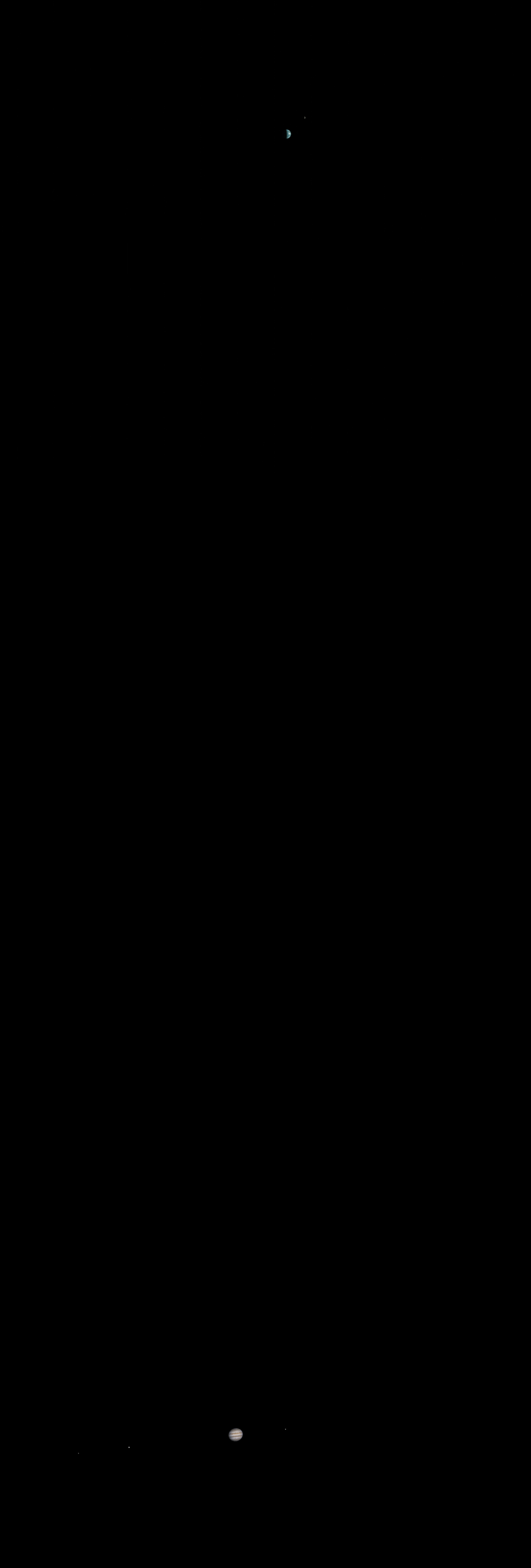
The image below is currently being passed around the web without attribution or explanation. Offering full-color views of Earth, the moon and Jupiter in the same shot, and it was taken by The Mars Global Surveyor. Be sure to click it to see it full-size.

Phil Plait at Bad Astronomy/Discover Magazine:
It’s images like this that remind us that we live on a planet, a world like any other and yet unique in that it’s our home. I get people asking me if space exploration is worth it, and then I see images like this, and I know the answer is yes. We need this perspective. It’s said that the Apollo 8 shot of the Earth rising over the Moon launched the modern environmental movement, because it showed all of us eggs sitting in our one, lone basket. We should be reminded of this idea as often as possible, and images like this one from the MOC need to be spread far and wide.

Thursday, October 15, 2009

Not Really Astronomy But Hey

Apparently there is a young, hip, Pittsburgh-based band called Sandbox Astronomy. Not only is the music loosely astronomy-themed, but their logo is amazing (see below).

I for one hope this band makes it "big" and spurs a new sub-genre of indie rock called "astronomusic," a David Bowie-inspired electropop experience in which the mic stands are telescopes and torn jeans are patched up with felt planets.

Monday, October 12, 2009

Across the Blogoverse: Bombing the Moon

So NASA bombed the moon on Thursday. Specifically, they fired some missiles at its poles in order to see if any water would be among the debris ejected upon impact. The mission was somewhat disappointing online, as the impact's visibility had apparently been overestimated (see video below). In addition, while the results will likely take weeks for NASA to analyze, it appears unlikely that any water or ice was kicked up. Over the past few days I've collected some of the most interesting content relating to the mission.
  • @Wired.com: Two separate features on its GeekDad blog on how to observe the impacts, either online or with simple telescopes.
  • @DiscoverMagazine.com: Phil Plait at the Bad Astronomy blog ran down the best ways to keep track of the lunar bombing as it happened. Note the awesome comment section
  • @HuffPo.com: The Huffington Post, despite its often shoddy science reporting, summed up the event nicely. They also embedded video, added graphics and compiled updates over the following days.

I'll leave you with NBC's live coverage (including some trippy infrared filters!) of the moon bombing. Note how utterly dejected Tom Costello is that NASA's satellites couldn't pick up the impact. You'd think a celebrity had just died or something.

Wednesday, October 7, 2009

Executive Astronomy

President Obama is hosting "Astronomy Night" on the White House's South Lawn tonight. The event will honor 13 of the nation's top innovators and inventors, and there will be upwards of 20 telescopes on the lawn for local elementary school students and middle schoolers to stargaze.

It's still extremely early to analyze the success of the Obama administration, but one thing's certain--through initiatives like these, he's doing his part to bolster the widespread scientific illiteracy in this country and encouraging curiosity.

Tuesday, October 6, 2009

A Fleeting Moment

The other night I stepped into my back alley for some fresh air. I noted that the alley was illuminated more than usual, I gazed up to see that the full moon was surrounded by a large, fuzzy halo. The clouds had happened to form a donut shape. The moon was in the hole.

It was pretty awesome, so I grabbed my camera to document it. Unfortunately, the clouds had dispersed by the time I got back outside. It was just the moon now, with a few wisps of cloud drifting away from it like protesters from a tear gas canister.

I debated not posting this because, after all, the sight had passed. Anyway, here's the photo, although it does virtually no justice. Click it to embiggen it.

Also, I promise after this I will not post anything about the moon for at least 3 days.

Sunday, October 4, 2009

Astronomy as an Act of Faith

The field of astronomy has done no small part in contradicting religion. Galileo's theory that the Sun, not the Earth, was the center of the universe landed him in the Roman Inquisition, and was eventually convicted of heresy and spent the last 10 years of his life under house arrest.

Andrew Sullivan links to a Walrus Magazine profile of Vatican astronomer Guy Consolmagno, who argues that religion and science--specifically astronomy--do not inherently contradict each other. Rather, he argues that astronomy allows us to appreciate the universe as a creation:

“Seeing the universe as God’s creation means that getting to play in the universe - which is really what a scientist does — is a way of playing with the Creator,” he says. “It’s a religious act. And it’s a very joyous act.”


I identify myself as a religious agnostic, but it's always nice to see faith and science complement one another. If people approach their religion flexibly, science and religion can better reconcile their differences.

Saturday, October 3, 2009

The Moon: Mankind's Constant

I live halfway up one of Oakland's most notorious hills, Chesterfield St. The view from the top, where it intersects with Terrace St., is spectacular, offering great views of the South Side and about as majestic a panorama one can get of South Oakland.

Walking home late last night, I paused at the top of the hill. Hovering above the rugged cobblestone, above the blaring streetlights of Oakland, and above the South Side's points of light and jagged horizon, was the moon. The clouds hid and revealed its glow in two-second intervals, moving from bottom to top, giving it the illusion that the moon was moving, not the clouds.

The moon has been observed as long as we've been around as a species, and its beauty is something people have marveled at and will likely continue to marvel at forever. Its no wonder ancient people constructed deities around the moon. It looms above everything else. No matter how good or bad your night was, whether America is on the right track or the wrong one, whether your favorite team wins or loses, the sun will go down at night and the moon will emerge above it all, shining down on every one of us, as if to say, "Hey, dude. Welcome home."

Wednesday, September 30, 2009

Two Stunners From Hubble

The Hubble in the past has given us the likes of the Hubble Deep Field images, which continue to boggle my mind. Today, it gave us two absolutely stunning images of two galaxies that are about 60 million light years away from Earth. The images are so detailed and crisp that the files both come in at about 30 megabites each. These two images put together will take up roughly the same amount on your hard drive as 60 minutes of high-quality music. If you've ever doubted that a picture is worth a thousand words, check out these babies (there are likely more stars in these images than words in the English language, FYI).


Sunday, September 27, 2009

NASA IMoTD for 9/28/09

Another nugget from the water-on-the-moon dept. The blue stuff represents regions that contain the mineralogical signature of good ol' H20.

Saturday, September 26, 2009

Water Wars: Mars Strikes Back

Well, spank my ass and call me Sally. The the Mars Reconnaissance Orbiter has detected sub-surface ice on Mars. According to Shane Byrne, a member of the organization that operates the HiRISE camera, the purity of the water goes against a long-standing theory that Martian ice tends to spread itself out among soil grains:
The thinking before was that ice accumulates below the surface between soil grains, so there would be a 50-50 mix of dirt and ice. We were able to figure out, given how long it took that ice to fade from view, that the mixture is about one percent dirt and 99 percent ice.
While these conclusions were gathered from a single shot of a specific, the recent discovery of water on the moon was drawn from spectroscopic images of the entire lunar surface.

Thus, the quickly-escalating Moon-Mars water rivalry seems almost artificially balanced:

Moon
Pro: We know water could comprise up to 1% of the lunar surface.
Con:
Since it's actually on the surface, in liquid form, our tools can't tell how "pure" or "dirty" the water actually is.

Mars
Pro:
Water is frozen in underground blocks, so scientists can deduce that it's almost certainly pure.
Con:
We don't know how widespread these sub-surface ice chunks really are.

This reminds me of Japanese Bug Fights--all the matchups are eerily even. The scorpion has the stealthy stinger, but has limited agility. The dung beetle has brute force, but it can't swim.

Science is fun. Everything is tangible, but rarely are things clear-cut.

Water on the Moon (AND WHY YOU SHOULD BE TERRIFIED)

Scientists have found water on the moon. These "experts" hail this as a landmark moment in astronomy. I disagree. This discovery can only mean one thing:

THE MOON IS CRYING. IT IS LOOKING DOWN ON US AND IT IS DISTURBED AT WHAT IT SEES. IT SEES SIN AND DESPAIR (AND IT HATES HATES HATES WHAT CHELSEA HANDLER IS DOING TO THE POPULAR CULTURE AND WHATNOT).

Tuesday, September 22, 2009

Prominent Astronomer At Work Since Her Teens

Usually when the phrase "13-year-old" and "telescope" are used in the same context, they are in reference to voyeurism. While Dr. Carolyn Porco used telescopes to admire Saturn's rings at that age, what the hell was I doing?

(This is a rhetorical question.)

Sunday, September 20, 2009

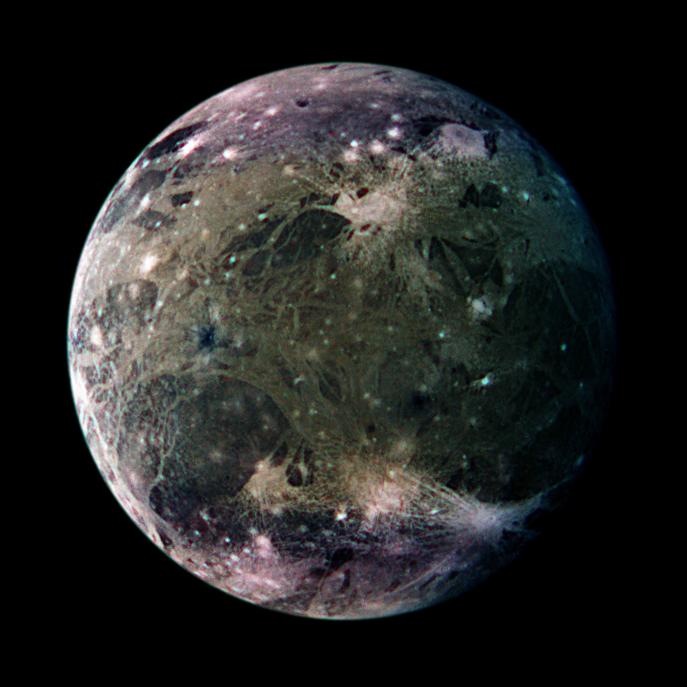
NASA Astronomy PoTD


This is NASA's Astronomy Picture of the Day, for Sept. 20, 2009. It's Ganymede, one of Jupiter's 63 confirmed moons, and the largest one in our entire Solar System. It's also twice the size of our own moon.

As you can see, it is pretty cool-looking. It was supposedly discovered by Galileo in 1610--he thought it was a star at the time, which is understandable considering the archaic equipment he worked with.

This photo was taken by the Galileo spacecraft (named in his honor), which orbited Jupiter from 1995 to 2003. Needless to say, if Galileo himself saw it, he'd probably shit his pants.

Life as We Don't Know It

The prawn-like creatures in summer blockbuster "District 9" develop an unhealthy addiction to cat food. This is simultaneously disgusting and hilarious to us, but the question of how hypothetical aliens might sustain themselves is incredibly open-ended. Researchers at the University of Vienna are looking into the possibility of life forms that sustain themselves on sources of energy uncontainable to humans:
One requirement for a life-supporting solvent is that it remains liquid over a large temperature range. Water is liquid between 0°C and 100°C, but other solvents exist which are liquid over more than 200 °C. Such a solvent would allow an ocean on a planet closer to the central star. The reverse scenario is also possible. A liquid ocean of ammonia could exist much further from a star. Furthermore, sulphuric acid can be found within the cloud layers of Venus and we now know that lakes of methane/ethane cover parts of the surface of the Saturnian satellite Titan.
Water is one of the foremost prerequisites for intelligent life, and astronomers have narrowed their search for aliens accordingly. If a planet isn't just the right distance from its star, then it won't have water, and it won't have aliens. When you take the whole water thing out of the equation, the possibilities increase exponentially.

If such life forms do exist, I picture street peddlers selling bottled sulphuric acid to gridlocked motorists next to the highway. They have evolved to sustain themselves on a charcoal-rich diet, and as a result, their skin is notably dry and damaged. We could sell them our Neutrogena, but it would probably be like acid to them and they'd likely misinterpret our dermatological altruism.

Don't Be Complainin' 'Bout No Global Warming

The moon (besides the Sun, of course) may be the most observed celestial object in human history. Yet we continue to learn new things about it.

Consider, this New York Times article, where we learn that the lunar climate isn't as temperate as we once thought:
In the newly released data, thermal measurements showed that daytime temperatures over much of the surface reached 220 degrees Fahrenheit — hotter than boiling water — before plummeting to frigidness at night.
But the bottoms of the craters, which lie in permanent darkness, never warm above minus 400.
This is particularly mind-blowing because the moon just looks cold—it’s all gray and rusty-looking; plus, it's most visible at night, when Earth temperatures are typically lower, and we tend to associate the moon with the nighttime chill that accompanies our observations of it.

The moon is the closest celestial object to Earth, yet apparently, its surface temperature routinely fluctuates between (in human terms) unbearably hot and unbearably cold. Of course, our lives on Earth wouldn’t be possible without our planet’s narrow temperature range.

Imagine you live in an apartment building. You have a neighbor two floors up, who insists on playing Mozart at all hours, at an inordinately high volume (you happen to like Mozart--quite a bit, in fact).

However, due to your relatively far distance from said neighbor within your building, the concertos are pleasantly faint, and you sleep quite well as a result. Your next door neighbor, Sherry, though, is directly below the Mozart fiend, and the music travels out his window and into hers. When Sherry closes her window, her apartment is stuffy and poorly-ventilated. But when it’s open, the Mozart is deafening. Your apartment is perfect, yet so close to an apartment that's downright unlivable.

Some lessons:
1. Mozart is awesome;
2. Always research your neighbors while apartment-hunting; and,
3. Take some time to appreciate your livable apartment, house, building, planet, etc.
The moon, man—you can freeze a turkey on its surface, and you can cook one.

Us

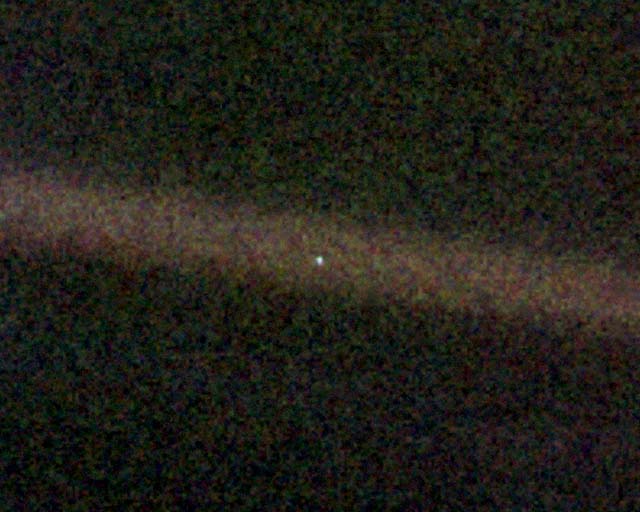
"Look again at that dot. That's here. That's home. That's us. On it everyone you love, everyone you know, everyone you ever heard of, every human being who ever was, lived out their lives. The aggregate of our joy and suffering, thousands of confident religions, ideologies, and economic doctrines, every hunter and forager, every hero and coward, every creator and destroyer of civilization, every king and peasant, every young couple in love, every mother and father, hopeful child, inventor and explorer, every teacher of morals, every corrupt politician, every "superstar," every "supreme leader," every saint and sinner in the history of our species lived there – on a mote of dust suspended in a sunbeam." -- Carl Sagan, astronomer of some note (1934-1996)

I tried using the above image as my desktop background for a short while last year, but it proved to be too damaging to my ego--if that blue dot is all we are, then who am I? How much of a difference can I really make in the world? How much will my Derek Jeter rookie card really be worth, when I'm gone? I'm cosmic bacteria!

These questions proved too lofty for my tastes, and I changed my wallpaper promptly.

Still, to quote a close friend of mine upon viewing "A Hitchhiker's Guide to the Galaxy," "Space is fucking insane!" It's true! In fact, you don't even need to be an astronomer to verify the truth of this statement. Space is fucking insane and all you need is a computer to experience its wonders.

This blog will explore the cosmos not from the perspective of a scientist or astronomer, but that of the plebeian--the little guy, suspended on a moat of dust, just lookin' around.