Friday, December 4, 2009

Spitzer: The Non-Adulterous-Governor Edition

NASA's Spitzer Space Telescope (a.k.a. Hubble's jealous little brother) has been putting together a mosaic of the Milky Way Galaxy for the past year for exhibition at the Adler Planetarium in Chicago. The prototype image was released this week, and it allows us to view our galaxy in unprecedented ways:
As inhabitants of a flat galactic disk, Earth and its solar system have an edge-on view of their host galaxy, like looking at a glass dish from its edge. From our perspective, most of the galaxy is condensed into a blurry narrow band of light that stretches completely around the sky, also known as the galactic plane.
The image is composed of over 800,000 separate images, each of them hi-res, each likely showing more detail than your average desktop wallpaper. Aside from the mosaic at Adler, the images will also allow astronomers to do statistical searches, estimate populations of objects and evaluate the contexts of celestial objects.

The main event (click to embiggen, then click again via magnifying glass to double-embiggen):

Sunrise

So I decided to wake up early today.


Sunday, November 22, 2009

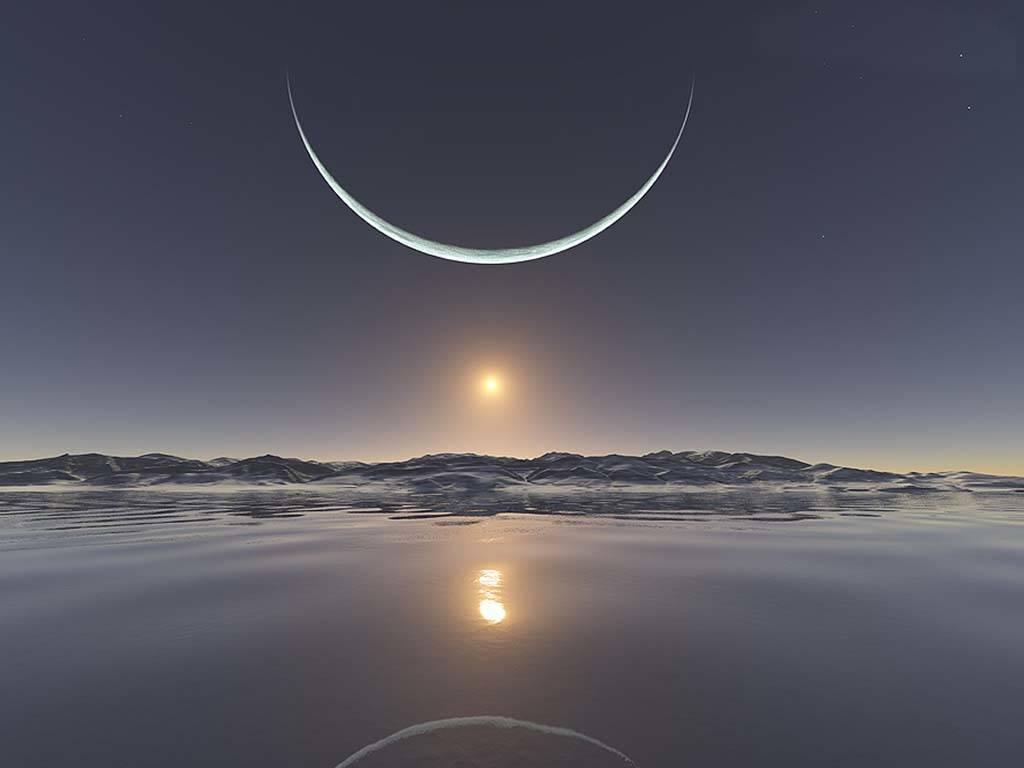
Sunset at the North Pole

(9:15:28 PM) kathryn: have you ever google image searched "north pole sunset"
(9:16:01 PM) ben: no
(9:16:09 PM) kathryn: well you should
(9:17:03 PM) ben: holy crap
(9:17:06 PM) ben: is that the moon?
(9:17:10 PM) kathryn: yeah
(9:17:22 PM) ben: hey
(9:17:26 PM) ben: kathryn. you. me.
(9:17:28 PM) ben: spring break.
(9:17:30 PM) ben: north pole.
(9:17:34 PM) kathryn: yeah, right
(9:17:36 PM) kathryn: nope.
(9:17:42 PM) kathryn: i want to go to the LOST island

If Only

The sky is as vast as it is diverse. When we gaze up into the night sky, we can see so many types of natural objects: stars, planets, meteors, comets, etc. But as diverse as they are, they have one thing in common--they're all round. From our perspective, aside from the Sun and moon, they're innocuous points of light.

It may seem obvious, but it's true. The closest non-round celestial "body" of course is Saturn's famous rings. It should be noted, though, that they are not actually solid rings but lots and lots of small particles of mostly ice and dust (which themselves are in fact round).

The main reason Earth doesn't have rings simply because it isn't big enough. Saturn, a gas giant, has relatively strong gravitational forces, which pulls the ring's particles in. (Fun fact: Jupiter also has rings--invisible rings!)

But what if Earth did have rings? What would it look like to us? Answer: Awesome.


Tuesday, November 17, 2009

"It was the kind of night a man could get some thinking done."

The above quote is actually the first sentence from a short story written by one of my fiction classmates. It also succinctly describes my endeavor last night, as I set out to catch me some meteors.

I went to sleep at 11 PM, woke up at 2 and met up with a friend at the apex of Chesterfield Rd. while donning a ravishing two-hoodie-camera-bulging-out-pocket-combo. Photographing a meteor is of course nearly impossible, and I brought the camera because I was about to traverse the exotic tundra of Northwest Oakland, U.S.A. in search of the best possible meteor viewing location, and such should be documented.

I would soon find that no such location existed. The clouds were like Swiss cheese--small holes here and there but very dense and hard to see through. Lights from streetlamps, hospitals and parking lots seemed to illuminate whichever pocket of the sky on which I currently focused my search. It was cold and windy, which made it hard for me to hold my camera steady and impossible to light a cigarette had my friend not been there to shield me.

At around 4 AM (when NASA says the shower should have peaked on the East Coast), we had yet to see any meteors. We alternately wandered around to find a better viewing spot and took sitting breaks wherever those spots were.

But wherever they were, no spot was "better" than the last. The city envelops the sky. It renders it partially inaccessible to city-dweller. There could have been a small cluster of meteors right in front of my eyes--UPMC Montefiore was just in the way.

So we just kind of sat a lot. The prolonged silences were mutually enjoyed. The sky, however inaccessible, is a nice backdrop for silence. It was the kind of night a man could get some thinking done.


This is where we finally settled, finally leaving at 4:14 EST.
Believe it or not, it was one of the more conducive lighting schemes.

Monday, November 16, 2009

The Pittsburgher's Guide to the 2009 Leonids Meteor Shower

Tonight through early tomorrow morning, the annual Leonids meteor shower will peak. This occurs as the Earth passes through a cloud of particles left over from deteriorated comets.

Obviously, for optimal viewing, you'll want to be in the darkest place possible. This may prove difficult for us city-dwellers, but NASA has a neat little widget on its website that lets you input your coordinates, conditions and viewing times, offering a rough estimate of the number of meteors you can expect to see. Below is the chart for greater Pittsburgh:


Note that the peak time for viewing will be at 2:28 local time, and we can expect to see around 2.5 meteors per hour then. Not spectacular by any stretch, but still more meteors than one can expect to see over the course of an entire year.

Sunday, November 15, 2009

Intro to the Drake Equation

Amid all of last week's Carl Sagan festivities, I came across this clip from the 1980 mini-series, "Cosmos," which Sagan helped write, produce, and starred in.

I first learned about the Drake equation in the very first class I ever attended at Pitt. It was called "Intelligent Life in the Universe," and the long-term goal of the class was to tangibly estimate the likelihood of human-like species existing elsewhere in the Universe. The equation (which was the culminating lesson of the course), was formulated by Dr. Frank Drake in 1960. Basically, what the formula does is take all of the variables involved in determining the existence of aliens (number of stars in the Universe, number of galaxies, evolutionary conditions, etc.) and enables a rough estimate for the number of intelligent civilizations in the Universe at a given time.

The clip below shows Sagan guiding the viewer through the equation. The kicker comes at the end, though--the difference between an incredibly populated Universe and a barren one hinges on civilizations' ability not to destroy themselves. In other words, if intelligent societies can avoid self-destruction, then the Universe is likely filled with worlds such as our own.


Yet another case for the disarmament of Iran.