Wednesday, September 30, 2009

Two Stunners From Hubble

The Hubble in the past has given us the likes of the Hubble Deep Field images, which continue to boggle my mind. Today, it gave us two absolutely stunning images of two galaxies that are about 60 million light years away from Earth. The images are so detailed and crisp that the files both come in at about 30 megabites each. These two images put together will take up roughly the same amount on your hard drive as 60 minutes of high-quality music. If you've ever doubted that a picture is worth a thousand words, check out these babies (there are likely more stars in these images than words in the English language, FYI).


Sunday, September 27, 2009

NASA IMoTD for 9/28/09

Another nugget from the water-on-the-moon dept. The blue stuff represents regions that contain the mineralogical signature of good ol' H20.

Saturday, September 26, 2009

Water Wars: Mars Strikes Back

Well, spank my ass and call me Sally. The the Mars Reconnaissance Orbiter has detected sub-surface ice on Mars. According to Shane Byrne, a member of the organization that operates the HiRISE camera, the purity of the water goes against a long-standing theory that Martian ice tends to spread itself out among soil grains:
The thinking before was that ice accumulates below the surface between soil grains, so there would be a 50-50 mix of dirt and ice. We were able to figure out, given how long it took that ice to fade from view, that the mixture is about one percent dirt and 99 percent ice.
While these conclusions were gathered from a single shot of a specific, the recent discovery of water on the moon was drawn from spectroscopic images of the entire lunar surface.

Thus, the quickly-escalating Moon-Mars water rivalry seems almost artificially balanced:

Moon
Pro: We know water could comprise up to 1% of the lunar surface.
Con:
Since it's actually on the surface, in liquid form, our tools can't tell how "pure" or "dirty" the water actually is.

Mars
Pro:
Water is frozen in underground blocks, so scientists can deduce that it's almost certainly pure.
Con:
We don't know how widespread these sub-surface ice chunks really are.

This reminds me of Japanese Bug Fights--all the matchups are eerily even. The scorpion has the stealthy stinger, but has limited agility. The dung beetle has brute force, but it can't swim.

Science is fun. Everything is tangible, but rarely are things clear-cut.

Water on the Moon (AND WHY YOU SHOULD BE TERRIFIED)

Scientists have found water on the moon. These "experts" hail this as a landmark moment in astronomy. I disagree. This discovery can only mean one thing:

THE MOON IS CRYING. IT IS LOOKING DOWN ON US AND IT IS DISTURBED AT WHAT IT SEES. IT SEES SIN AND DESPAIR (AND IT HATES HATES HATES WHAT CHELSEA HANDLER IS DOING TO THE POPULAR CULTURE AND WHATNOT).

Tuesday, September 22, 2009

Prominent Astronomer At Work Since Her Teens

Usually when the phrase "13-year-old" and "telescope" are used in the same context, they are in reference to voyeurism. While Dr. Carolyn Porco used telescopes to admire Saturn's rings at that age, what the hell was I doing?

(This is a rhetorical question.)

Sunday, September 20, 2009

NASA Astronomy PoTD


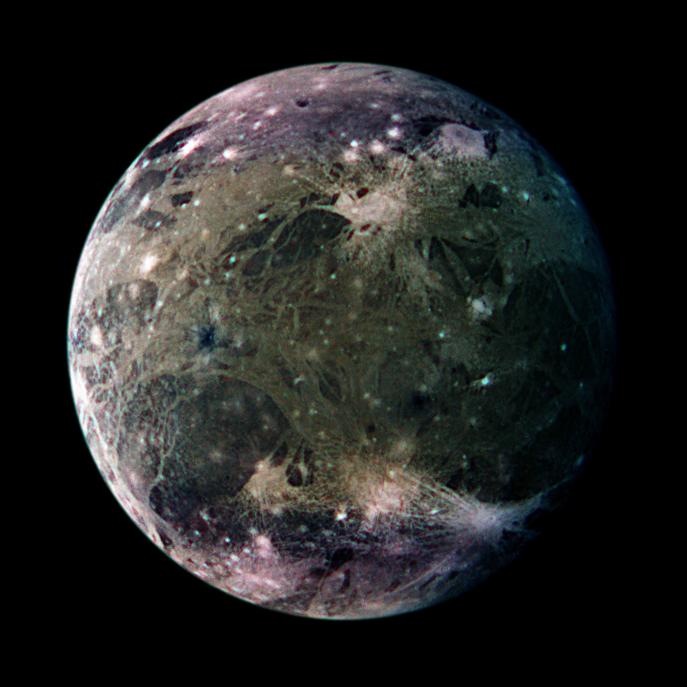
This is NASA's Astronomy Picture of the Day, for Sept. 20, 2009. It's Ganymede, one of Jupiter's 63 confirmed moons, and the largest one in our entire Solar System. It's also twice the size of our own moon.

As you can see, it is pretty cool-looking. It was supposedly discovered by Galileo in 1610--he thought it was a star at the time, which is understandable considering the archaic equipment he worked with.

This photo was taken by the Galileo spacecraft (named in his honor), which orbited Jupiter from 1995 to 2003. Needless to say, if Galileo himself saw it, he'd probably shit his pants.

Life as We Don't Know It

The prawn-like creatures in summer blockbuster "District 9" develop an unhealthy addiction to cat food. This is simultaneously disgusting and hilarious to us, but the question of how hypothetical aliens might sustain themselves is incredibly open-ended. Researchers at the University of Vienna are looking into the possibility of life forms that sustain themselves on sources of energy uncontainable to humans:
One requirement for a life-supporting solvent is that it remains liquid over a large temperature range. Water is liquid between 0°C and 100°C, but other solvents exist which are liquid over more than 200 °C. Such a solvent would allow an ocean on a planet closer to the central star. The reverse scenario is also possible. A liquid ocean of ammonia could exist much further from a star. Furthermore, sulphuric acid can be found within the cloud layers of Venus and we now know that lakes of methane/ethane cover parts of the surface of the Saturnian satellite Titan.
Water is one of the foremost prerequisites for intelligent life, and astronomers have narrowed their search for aliens accordingly. If a planet isn't just the right distance from its star, then it won't have water, and it won't have aliens. When you take the whole water thing out of the equation, the possibilities increase exponentially.

If such life forms do exist, I picture street peddlers selling bottled sulphuric acid to gridlocked motorists next to the highway. They have evolved to sustain themselves on a charcoal-rich diet, and as a result, their skin is notably dry and damaged. We could sell them our Neutrogena, but it would probably be like acid to them and they'd likely misinterpret our dermatological altruism.

Don't Be Complainin' 'Bout No Global Warming

The moon (besides the Sun, of course) may be the most observed celestial object in human history. Yet we continue to learn new things about it.

Consider, this New York Times article, where we learn that the lunar climate isn't as temperate as we once thought:
In the newly released data, thermal measurements showed that daytime temperatures over much of the surface reached 220 degrees Fahrenheit — hotter than boiling water — before plummeting to frigidness at night.
But the bottoms of the craters, which lie in permanent darkness, never warm above minus 400.
This is particularly mind-blowing because the moon just looks cold—it’s all gray and rusty-looking; plus, it's most visible at night, when Earth temperatures are typically lower, and we tend to associate the moon with the nighttime chill that accompanies our observations of it.

The moon is the closest celestial object to Earth, yet apparently, its surface temperature routinely fluctuates between (in human terms) unbearably hot and unbearably cold. Of course, our lives on Earth wouldn’t be possible without our planet’s narrow temperature range.

Imagine you live in an apartment building. You have a neighbor two floors up, who insists on playing Mozart at all hours, at an inordinately high volume (you happen to like Mozart--quite a bit, in fact).

However, due to your relatively far distance from said neighbor within your building, the concertos are pleasantly faint, and you sleep quite well as a result. Your next door neighbor, Sherry, though, is directly below the Mozart fiend, and the music travels out his window and into hers. When Sherry closes her window, her apartment is stuffy and poorly-ventilated. But when it’s open, the Mozart is deafening. Your apartment is perfect, yet so close to an apartment that's downright unlivable.

Some lessons:
1. Mozart is awesome;
2. Always research your neighbors while apartment-hunting; and,
3. Take some time to appreciate your livable apartment, house, building, planet, etc.
The moon, man—you can freeze a turkey on its surface, and you can cook one.

Us

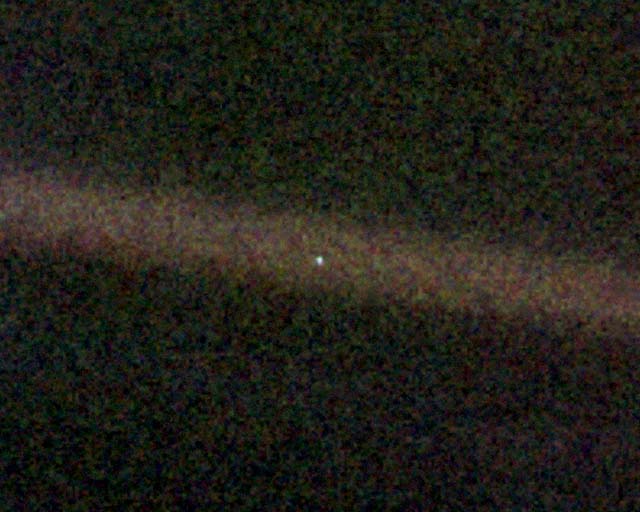
"Look again at that dot. That's here. That's home. That's us. On it everyone you love, everyone you know, everyone you ever heard of, every human being who ever was, lived out their lives. The aggregate of our joy and suffering, thousands of confident religions, ideologies, and economic doctrines, every hunter and forager, every hero and coward, every creator and destroyer of civilization, every king and peasant, every young couple in love, every mother and father, hopeful child, inventor and explorer, every teacher of morals, every corrupt politician, every "superstar," every "supreme leader," every saint and sinner in the history of our species lived there – on a mote of dust suspended in a sunbeam." -- Carl Sagan, astronomer of some note (1934-1996)

I tried using the above image as my desktop background for a short while last year, but it proved to be too damaging to my ego--if that blue dot is all we are, then who am I? How much of a difference can I really make in the world? How much will my Derek Jeter rookie card really be worth, when I'm gone? I'm cosmic bacteria!

These questions proved too lofty for my tastes, and I changed my wallpaper promptly.

Still, to quote a close friend of mine upon viewing "A Hitchhiker's Guide to the Galaxy," "Space is fucking insane!" It's true! In fact, you don't even need to be an astronomer to verify the truth of this statement. Space is fucking insane and all you need is a computer to experience its wonders.

This blog will explore the cosmos not from the perspective of a scientist or astronomer, but that of the plebeian--the little guy, suspended on a moat of dust, just lookin' around.