Sunday, November 22, 2009

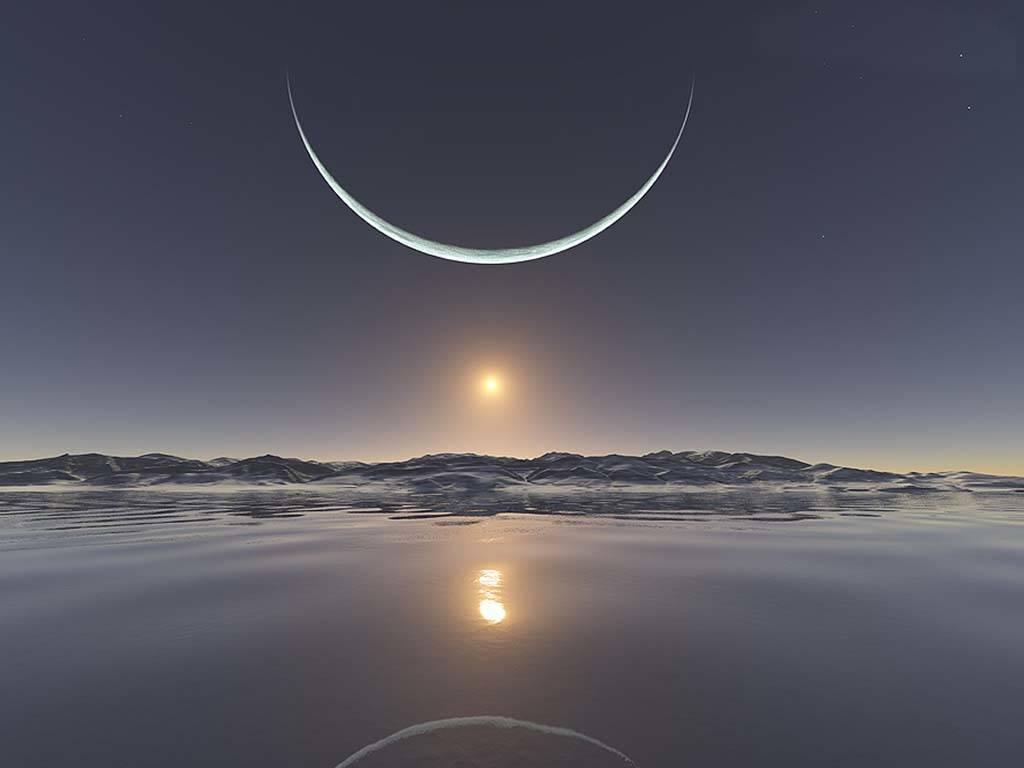
Sunset at the North Pole

(9:15:28 PM) kathryn: have you ever google image searched "north pole sunset"
(9:16:01 PM) ben: no
(9:16:09 PM) kathryn: well you should
(9:17:03 PM) ben: holy crap
(9:17:06 PM) ben: is that the moon?
(9:17:10 PM) kathryn: yeah
(9:17:22 PM) ben: hey
(9:17:26 PM) ben: kathryn. you. me.
(9:17:28 PM) ben: spring break.
(9:17:30 PM) ben: north pole.
(9:17:34 PM) kathryn: yeah, right
(9:17:36 PM) kathryn: nope.
(9:17:42 PM) kathryn: i want to go to the LOST island

If Only

The sky is as vast as it is diverse. When we gaze up into the night sky, we can see so many types of natural objects: stars, planets, meteors, comets, etc. But as diverse as they are, they have one thing in common--they're all round. From our perspective, aside from the Sun and moon, they're innocuous points of light.

It may seem obvious, but it's true. The closest non-round celestial "body" of course is Saturn's famous rings. It should be noted, though, that they are not actually solid rings but lots and lots of small particles of mostly ice and dust (which themselves are in fact round).

The main reason Earth doesn't have rings simply because it isn't big enough. Saturn, a gas giant, has relatively strong gravitational forces, which pulls the ring's particles in. (Fun fact: Jupiter also has rings--invisible rings!)

But what if Earth did have rings? What would it look like to us? Answer: Awesome.


Tuesday, November 17, 2009

"It was the kind of night a man could get some thinking done."

The above quote is actually the first sentence from a short story written by one of my fiction classmates. It also succinctly describes my endeavor last night, as I set out to catch me some meteors.

I went to sleep at 11 PM, woke up at 2 and met up with a friend at the apex of Chesterfield Rd. while donning a ravishing two-hoodie-camera-bulging-out-pocket-combo. Photographing a meteor is of course nearly impossible, and I brought the camera because I was about to traverse the exotic tundra of Northwest Oakland, U.S.A. in search of the best possible meteor viewing location, and such should be documented.

I would soon find that no such location existed. The clouds were like Swiss cheese--small holes here and there but very dense and hard to see through. Lights from streetlamps, hospitals and parking lots seemed to illuminate whichever pocket of the sky on which I currently focused my search. It was cold and windy, which made it hard for me to hold my camera steady and impossible to light a cigarette had my friend not been there to shield me.

At around 4 AM (when NASA says the shower should have peaked on the East Coast), we had yet to see any meteors. We alternately wandered around to find a better viewing spot and took sitting breaks wherever those spots were.

But wherever they were, no spot was "better" than the last. The city envelops the sky. It renders it partially inaccessible to city-dweller. There could have been a small cluster of meteors right in front of my eyes--UPMC Montefiore was just in the way.

So we just kind of sat a lot. The prolonged silences were mutually enjoyed. The sky, however inaccessible, is a nice backdrop for silence. It was the kind of night a man could get some thinking done.


This is where we finally settled, finally leaving at 4:14 EST.
Believe it or not, it was one of the more conducive lighting schemes.

Monday, November 16, 2009

The Pittsburgher's Guide to the 2009 Leonids Meteor Shower

Tonight through early tomorrow morning, the annual Leonids meteor shower will peak. This occurs as the Earth passes through a cloud of particles left over from deteriorated comets.

Obviously, for optimal viewing, you'll want to be in the darkest place possible. This may prove difficult for us city-dwellers, but NASA has a neat little widget on its website that lets you input your coordinates, conditions and viewing times, offering a rough estimate of the number of meteors you can expect to see. Below is the chart for greater Pittsburgh:


Note that the peak time for viewing will be at 2:28 local time, and we can expect to see around 2.5 meteors per hour then. Not spectacular by any stretch, but still more meteors than one can expect to see over the course of an entire year.

Sunday, November 15, 2009

Intro to the Drake Equation

Amid all of last week's Carl Sagan festivities, I came across this clip from the 1980 mini-series, "Cosmos," which Sagan helped write, produce, and starred in.

I first learned about the Drake equation in the very first class I ever attended at Pitt. It was called "Intelligent Life in the Universe," and the long-term goal of the class was to tangibly estimate the likelihood of human-like species existing elsewhere in the Universe. The equation (which was the culminating lesson of the course), was formulated by Dr. Frank Drake in 1960. Basically, what the formula does is take all of the variables involved in determining the existence of aliens (number of stars in the Universe, number of galaxies, evolutionary conditions, etc.) and enables a rough estimate for the number of intelligent civilizations in the Universe at a given time.

The clip below shows Sagan guiding the viewer through the equation. The kicker comes at the end, though--the difference between an incredibly populated Universe and a barren one hinges on civilizations' ability not to destroy themselves. In other words, if intelligent societies can avoid self-destruction, then the Universe is likely filled with worlds such as our own.


Yet another case for the disarmament of Iran.

Bombing the Moon: Update

You may remember that last month, NASA bombed the moon. The purpose was to see if water and ice would kick up amid all the debris, and the tests just came back:

It's official: the moon is pregnant. Just kidding--its water just broke. Via the NYT Science section:

“Indeed yes, we found water,” Anthony Colaprete, the principal investigator for NASA’s Lunar Crater Observation and Sensing Satellite, said in a news conference. “And we didn’t find just a little bit. We found a significant amount.”

The confirmation of scientists’ suspicions is welcome news to explorers who might set up home on the lunar surface and to scientists who hope that the water, in the form of ice accumulated over billions of years, holds a record of the solar system’s history.

So, why is this important? Well, in terms of the long term viability of our species, water might be the first natural resource to go. If humans have a future on Earth (or elsewhere), the difference between trace amounts of lunar water and large deposits (apparently among the LCROSS findings) is roughly equal to the difference between a species that fizzles in the next few millennia and one that lasts much, much longer.

Sunday, November 8, 2009

Astronomusic v. 3: Carl Sagan in Auto-Tune

Speaking of Carl Sagan, here's a tribute courtesy of John Boswell (through his project Symphony of Science, which was promoted on the science podcast The Skeptics' Guide to the Universe). And you thought auto-tune was just for T-Pain.

Check it:


Fail

Last night at 10:17 PM I received the following text message from my friend Rachael:
Holy fuck go take a picture of the moon!!! It looks fake. Holy crap its huge.
I put my slippers on, grabbed my camera and stepped onto my porch. My house resides halfway up Chesterfield St., one of Oakland's most notorious hills, but alas, the moon was not visible from my porch.

I walked up the hill (no luck), then further and further up. I still could not see the supposedly holy-fuck-fake-looking-huge moon. I then walked all the way down my street, past my house until I reached sea level. Still nothing. I then proceeded to take another walk around my block, just for good measure. The moon was nowhere to be found.

I began to suspect that I had just been "punk'd." Rachael knows about this blog and its purpose, and her text message, I suspected, might simply have been a practical joke carefully orchestrated to make me walk around Oakland aimlessly for 20 minutes.

Apparently, I was wrong--the moon truly was holy-fuck-huge last night. How did I confirm this? Twitter, of course. <3 Web 2.0. Click to embiggen:


This serves as my only documentation of the holy-fuck-huge-moon of Nov. 7. Rachael now tells me that the moon was pretty low, so the normally underwhelming Oakland skyline was probably obscuring my view.

This also serves as this blog's first "failure" of sorts. Andrew Sullivan would be proud.
Saturday, November 7, 2009

Carl Sagan Day

Phil Plait at Bad Astronomy reported that today, November 7, is Carl Sagan Day at Broward College in South Florida. Carl Sagan, if you don't know, was an astronomer and scientist who was probably most responsible for the rapid popularization of science that occurred in the late twentieth century. He wrote books like Pale Blue Dot (quoted in this blog's inaugural post) and The Demon-Haunted World, which pushed the natural wonder of the universe into the mainstream media for the first time. Plait documented the event at his Twitter account.

A parting quote:

A scientific colleague tells me about a recent trip to the New Guinea highlands where she visited a stone age culture hardly contacted by Western civilization. They were ignorant of wristwatches, soft drinks, and frozen food. But they knew about Apollo 11. They knew that humans had walked on the Moon. They knew the names of Armstrong and Aldrin and Collins. They wanted to know who was visiting the Moon these days.

- Carl Sagan

(Thanks to Joel for the tip on this one.)

Sunday, November 1, 2009

Help?

I'm taking a class called Rhetoric of Science. Basically, it's about how the media represents scientific issues, the public's understanding of science, etc.

I've decided to write my term paper on the mainstream media's descriptions of dark matter. If you don't know what dark matter is: good! I'm looking to examine if the media oversimplifies the concept, explains it correctly/concisely, etc. Here's what you can do if you have a few extra minutes:

1. Quickly skim this NYT article.
2. Then this Scientific American article.
3. Come back here and explain dark matter in your own words, in like, two sentences max.
4. Get quoted by me in my paper.
5. Be awesome.

Obligatory Halloween Post/Astronomusic v. 2

Seen a shooting star tonight
And I thought of you.

You were trying to break into another world

A world I never knew.

I always kind of wondered
If you ever made it through.
Seen a shooting star tonight
And I thought of you.

- Bob Dylan, "Shooting Star," off the album Oh Mercy (1989)