Sunday, October 25, 2009

Sun Day

Pittsburgh was spectacular today. I sat in Schenley Plaza with a friend and we both searched for clouds. We were unsuccessful. Oakland was a beaming oasis of not just college folk but hoards of alumni back in town for a thing called "Homecoming."

I sort of felt like I was in Boca Raton, FL today. It was creepy.

I apologize for the quality of the below shot. It was taken with my phone. Check out the mad pretty colors:

Great Moments in Astronomy: Daylight Savings Time

Hey! Did you know that Daylight Savings time is roughly related to astronomy? It's true!; we do it so we can have more daylight hours in the afternoons, which we accomplish by taking them away from the mornings. You know this is true because it says so on the Internet.

I know what you're thinking. "Is Daylight Savings Time the one where you move the clock backward or the one where you go forward?"

Actually, Daylight Savings Time is ending on November 1, which means you'll set your clock back an hour. I wish I had a pithy rhyme to make remembering this easier. Sorry!

Wednesday, October 21, 2009

More Planets in our Midst

Fourth grade science was easy. When it came to memorizing the names of the nine planets in our solar system, you had a few ways to manipulate the MVEMJSUNP acronym:
  • My Very Excellent Mother Just Sent Us Nine Pizzas
  • Maybe Very Enraged Men Just Shouldn't Usurp the Ninth
  • My Very Easy Method Just Speeds Up Naming Planets
Etc.

Now, Pluto isn't even a planet. To boot, the uniqueness of our solar system is also dwindling--European astronomers just discovered 32 new planets outside our solar system. The discovery increased the number of planets discovered outside the solar system to more than 400. According to Stephane Udry of the University of Geneva, this is very good news:
''I'm pretty confident that there are Earth-like planets everywhere,'' Udry said in a Web-based news briefing from a conference in Portugal. ''Nature doesn't like a vacuum. If there is space to put a planet there, there will be a planet there.''
I'll get working on that 400-letter acronym now.

My
Very
Eager
Monkey
. . .

Suggestions?

Saturday, October 17, 2009

Not Really Astronomy But Hey v. 2.0

If you haven't heard of the Large Hadron Collider, consider this: build an 17-mile-long circular tunnel underneath Geneva, and then fire protons into one another at super high speeds...just to see what happens.

Hypothetically, the project (which is perhaps the largest scientific project in human history) could produce the Higgs boson, a (hypothetical) super-tiny particle which (theoretically) imbues all atoms with what we call "mass." The project has several astronomy-related implications, namely that when operated at full force, the LHC could reproduce the conditions present immediately after the Big Bang in which Higgs bosons roamed the cosmos freely before atoms quickly wrangled them and made them their own for all of eternity...until now?

Anyfart, the New York Times ran a great piece this week about a couple of physicists who think that the LHC has so much potential that its numerous breakdowns as of late may be attributed to the fact that the machine is being sabotaged by its own future. Thankfully, the journalist, Dennis Overbye, approaches these claims skeptically and points out that the theory is not widely accepted by any stretch, though we should still lend it an ear:

A pair of otherwise distinguished physicists have suggested that the hypothesized Higgs boson, which physicists hope to produce with the collider, might be so abhorrent to nature that its creation would ripple backward through time and stop the collider before it could make one, like a time traveler who goes back in time to kill his grandfather.

...

Sure, it’s crazy, and CERN should not and is not about to mortgage its investment to a coin toss. The theory was greeted on some blogs with comparisons to Harry Potter. But craziness has a fine history in a physics that talks routinely about cats being dead and alive at the same time and about anti-gravity puffing out the universe.

As Niels Bohr, Dr. Nielsen’s late countryman and one of the founders of quantum theory, once told a colleague: “We are all agreed that your theory is crazy. The question that divides us is whether it is crazy enough to have a chance of being correct.”

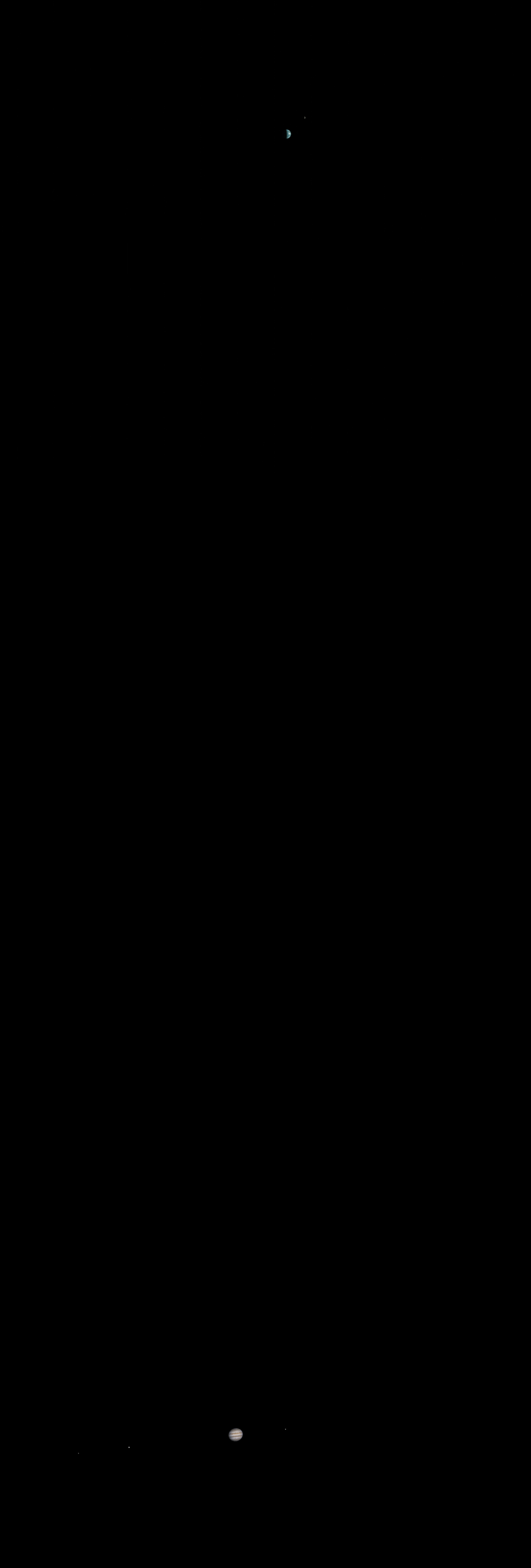
Solar Family Portrait

The image below is currently being passed around the web without attribution or explanation. Offering full-color views of Earth, the moon and Jupiter in the same shot, and it was taken by The Mars Global Surveyor. Be sure to click it to see it full-size.

Phil Plait at Bad Astronomy/Discover Magazine:
It’s images like this that remind us that we live on a planet, a world like any other and yet unique in that it’s our home. I get people asking me if space exploration is worth it, and then I see images like this, and I know the answer is yes. We need this perspective. It’s said that the Apollo 8 shot of the Earth rising over the Moon launched the modern environmental movement, because it showed all of us eggs sitting in our one, lone basket. We should be reminded of this idea as often as possible, and images like this one from the MOC need to be spread far and wide.
Thursday, October 15, 2009

Not Really Astronomy But Hey

Apparently there is a young, hip, Pittsburgh-based band called Sandbox Astronomy. Not only is the music loosely astronomy-themed, but their logo is amazing (see below).

I for one hope this band makes it "big" and spurs a new sub-genre of indie rock called "astronomusic," a David Bowie-inspired electropop experience in which the mic stands are telescopes and torn jeans are patched up with felt planets.

Monday, October 12, 2009

Across the Blogoverse: Bombing the Moon

So NASA bombed the moon on Thursday. Specifically, they fired some missiles at its poles in order to see if any water would be among the debris ejected upon impact. The mission was somewhat disappointing online, as the impact's visibility had apparently been overestimated (see video below). In addition, while the results will likely take weeks for NASA to analyze, it appears unlikely that any water or ice was kicked up. Over the past few days I've collected some of the most interesting content relating to the mission.
  • @Wired.com: Two separate features on its GeekDad blog on how to observe the impacts, either online or with simple telescopes.
  • @DiscoverMagazine.com: Phil Plait at the Bad Astronomy blog ran down the best ways to keep track of the lunar bombing as it happened. Note the awesome comment section
  • @HuffPo.com: The Huffington Post, despite its often shoddy science reporting, summed up the event nicely. They also embedded video, added graphics and compiled updates over the following days.

I'll leave you with NBC's live coverage (including some trippy infrared filters!) of the moon bombing. Note how utterly dejected Tom Costello is that NASA's satellites couldn't pick up the impact. You'd think a celebrity had just died or something.

Wednesday, October 7, 2009

Executive Astronomy

President Obama is hosting "Astronomy Night" on the White House's South Lawn tonight. The event will honor 13 of the nation's top innovators and inventors, and there will be upwards of 20 telescopes on the lawn for local elementary school students and middle schoolers to stargaze.

It's still extremely early to analyze the success of the Obama administration, but one thing's certain--through initiatives like these, he's doing his part to bolster the widespread scientific illiteracy in this country and encouraging curiosity.

Tuesday, October 6, 2009

A Fleeting Moment

The other night I stepped into my back alley for some fresh air. I noted that the alley was illuminated more than usual, I gazed up to see that the full moon was surrounded by a large, fuzzy halo. The clouds had happened to form a donut shape. The moon was in the hole.

It was pretty awesome, so I grabbed my camera to document it. Unfortunately, the clouds had dispersed by the time I got back outside. It was just the moon now, with a few wisps of cloud drifting away from it like protesters from a tear gas canister.

I debated not posting this because, after all, the sight had passed. Anyway, here's the photo, although it does virtually no justice. Click it to embiggen it.

Also, I promise after this I will not post anything about the moon for at least 3 days.

Sunday, October 4, 2009

Astronomy as an Act of Faith

The field of astronomy has done no small part in contradicting religion. Galileo's theory that the Sun, not the Earth, was the center of the universe landed him in the Roman Inquisition, and was eventually convicted of heresy and spent the last 10 years of his life under house arrest.

Andrew Sullivan links to a Walrus Magazine profile of Vatican astronomer Guy Consolmagno, who argues that religion and science--specifically astronomy--do not inherently contradict each other. Rather, he argues that astronomy allows us to appreciate the universe as a creation:

“Seeing the universe as God’s creation means that getting to play in the universe - which is really what a scientist does — is a way of playing with the Creator,” he says. “It’s a religious act. And it’s a very joyous act.”


I identify myself as a religious agnostic, but it's always nice to see faith and science complement one another. If people approach their religion flexibly, science and religion can better reconcile their differences.

Saturday, October 3, 2009

The Moon: Mankind's Constant

I live halfway up one of Oakland's most notorious hills, Chesterfield St. The view from the top, where it intersects with Terrace St., is spectacular, offering great views of the South Side and about as majestic a panorama one can get of South Oakland.

Walking home late last night, I paused at the top of the hill. Hovering above the rugged cobblestone, above the blaring streetlights of Oakland, and above the South Side's points of light and jagged horizon, was the moon. The clouds hid and revealed its glow in two-second intervals, moving from bottom to top, giving it the illusion that the moon was moving, not the clouds.

The moon has been observed as long as we've been around as a species, and its beauty is something people have marveled at and will likely continue to marvel at forever. Its no wonder ancient people constructed deities around the moon. It looms above everything else. No matter how good or bad your night was, whether America is on the right track or the wrong one, whether your favorite team wins or loses, the sun will go down at night and the moon will emerge above it all, shining down on every one of us, as if to say, "Hey, dude. Welcome home."